Skip to content

Text

“A shrill, grating voice rang out. The yelling was not in chorus. Each* took a turn and at the end of each the crowd broke into howls and roars and whistles of applause. This is what they had come to see and hear.

No newspaper had printed the words these women shouted. It was indicated that they were indelicate, some even said obscene. On television the sound track was made to blur or had crowd noises cut in to cover. But now I heard the words, bestial and filthy and degenerate.”

-John Steinbeck, Travels with Charley in Search of America, 1962

Images

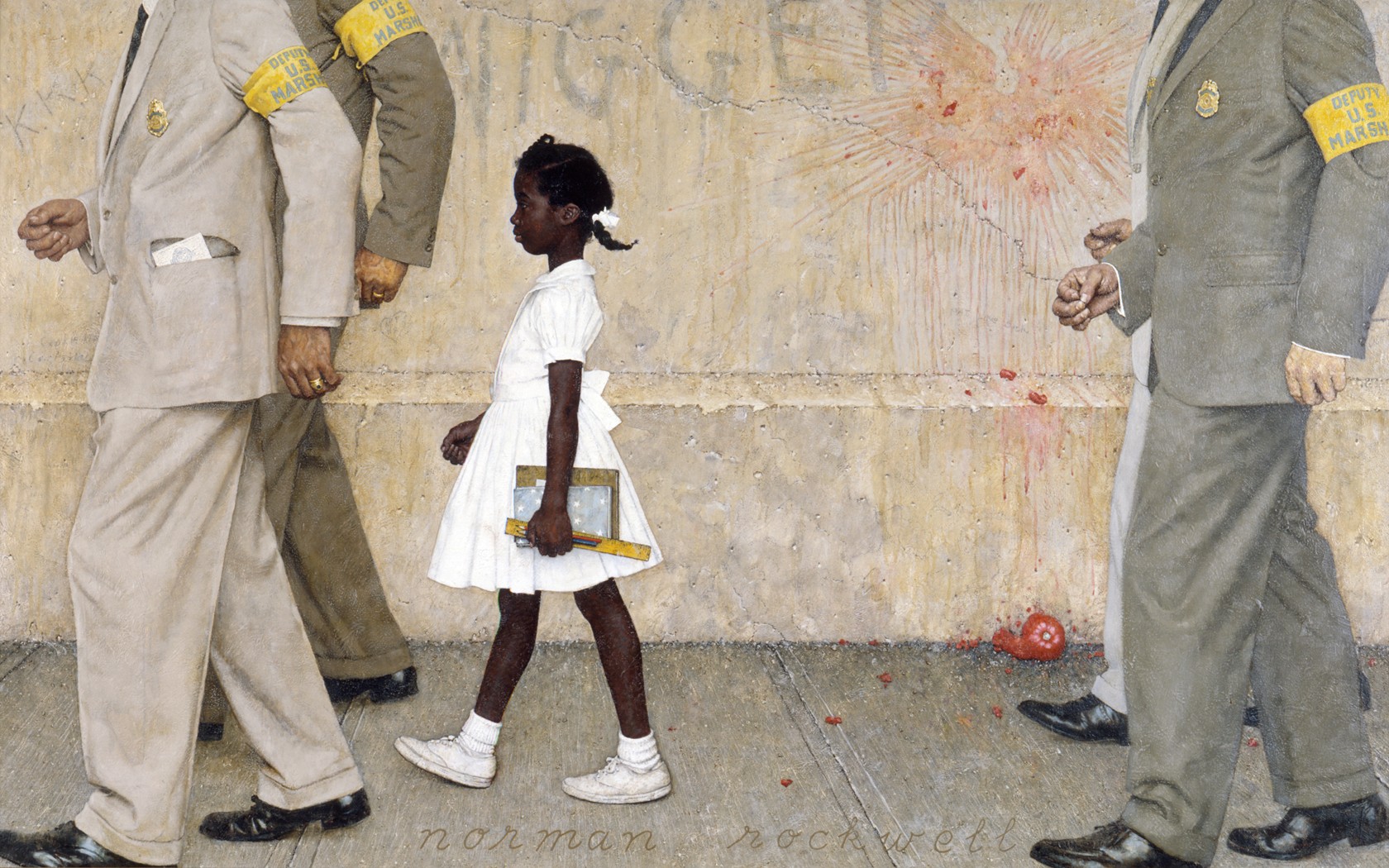
Norman Rockwell (American, 1894–1978), The Problem We All Live With, 1963. Oil on canvas, 36 x 58 in. (91 x 150 cm). Illustration for Look, January 14, 1964, 22–23. Norman Rockwell Museum Collection, NRM.1975.01

Text

The Problem We All Live With, Norman Rockwell’s iconic illustration, serves as a defining artifact of the Civil Rights Movement and a global symbol of education as a human right. Despite its prominence, the circumstances surrounding its creation are frequently misunderstood. Participants in a 2024 Terra Foundation–funded initiative assert that the perspectives of individuals who shaped and experienced the depicted events are critical to the interpretation of this artwork.

Images

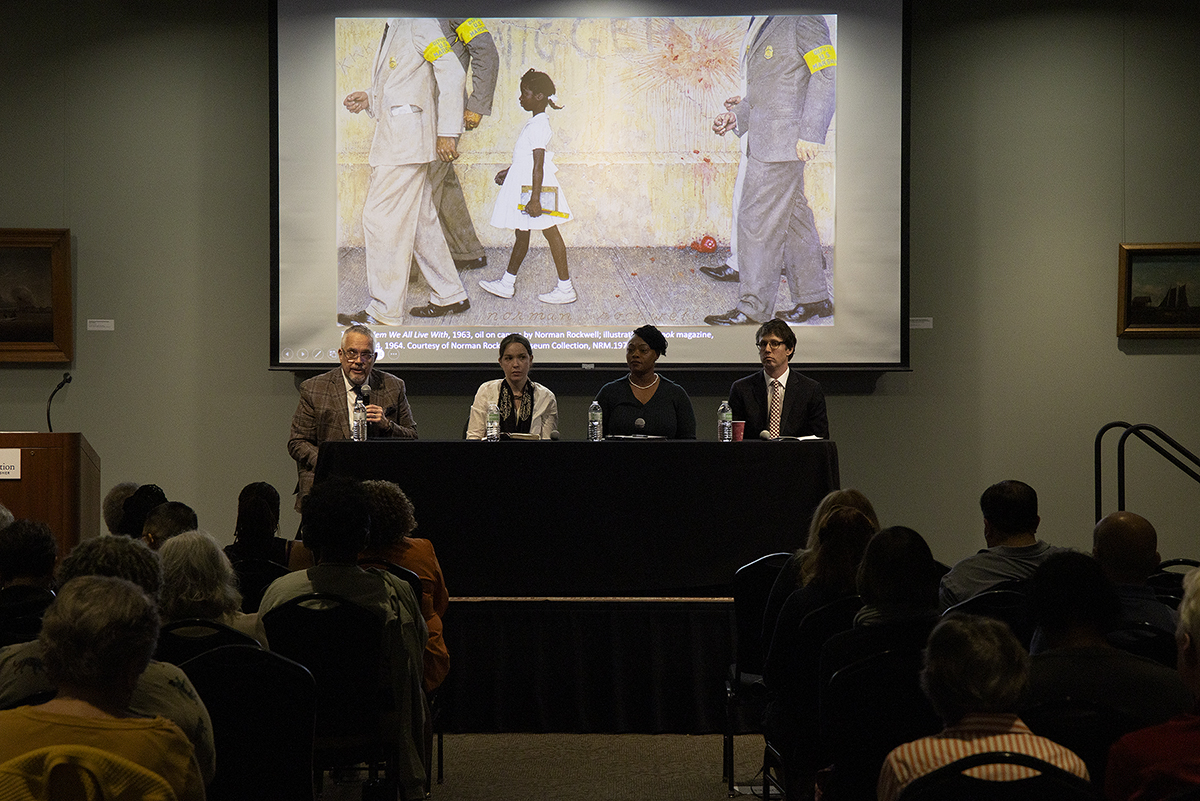
Panelists and New Orleans community members at “The Problem We All Live With: The Story of an Iconic Illustration,” film screening and panel discussion, November 15, 2025, at The Historic New Orleans Collection. Front row: Doratha “Dodie” Smith Simmons, Dorothy Smith Venison, Gail Etienne, Dorothy Prevost, and Tory Prevost. Back row: Sabrina May, Diedra Meredith, Eric Seiferth, Rich Bradway, Dr. Barbara-Shae Jackson, and Margot Yale. Photo courtesy of the Norman Rockwell Museum. (Dorothy Prevost passed away on February 20, 2026.)

Text

The Norman Rockwell Museum, which holds the original painting from 1963, received a grant from the foundation to collaborate with New Orleans community members and Civil Rights leaders. The original project scope included producing a short film, and the painting’s narrative label has been revised. Archival sources have also been central to the initiative. According to Turry M. Flucker, Vice President of Collections and Partnerships at the Terra Foundation for American Art, “This project is a powerful example of the Terra Foundation’s mission to expand narratives of American art. It also advances the foundation’s commitment to transformative practice and the healing potential of visual art. The New Orleans community is close-knit and welcoming; however, the legacy of chattel slavery and Jim and Jane Crow laws persist. This project seeks to dismantle longstanding barriers and guide the narrative toward truth and reconciliation.”

Quotation

“The New Orleans community is close-knit and welcoming; however, the legacy of chattel slavery and Jim and Jane Crow laws persist. This project seeks to dismantle longstanding barriers and guide the narrative toward truth and reconciliation.”

Turry M. Flucker, Vice President of Collections and Partnerships at the Terra Foundation for American Art

Text

The Norman Rockwell Museum project team partnered with Slover Linett at NORC at the University of Chicago to facilitate community conversations and engaged an external researcher for interpretive guidance. As interviews progressed, the team expanded the project to include a full documentary. On November 14, 2025, an in-development version of the film was screened at the Historic New Orleans Collection, commemorating the sixty-fifth anniversary of a pivotal day for several New Orleans families and four school-age children. In the video, Diedra Meredith, Director of the New Orleans Legacy project, states: “Gail Etienne, Ruby Bridges, Leona Tate, and Tessie Prevost. Those four girls, as six-year-olds, were the first to desegregate New Orleans’s public elementary schools on November 14, 1960.” The NRM team incorporated feedback received from this screening as well as from an additional private screening for community members. Based on the feedback received, the documentary now goes into greater depth to explore Rockwell’s intentions and career path.

Images

The Problem We All Live With: The Story of an Iconic Illustration,” film screening and panel discussion, November 15, 2025, at The Historic New Orleans Collection. Left to right: Rich Bradway, Director of Digital Learning and Engagement, Norman Rockwell Museum; Margot Yale, Project Research Advisor for Interpretation, Norman Rockwell Museum; Dr. Barbara-Shae Jackson, Research Scientist, Slover Linett at NORC at the University of Chicago; and Eric Seiferth, HNOC curator and historian. Photo courtesy of the Norman Rockwell Museum.

Text

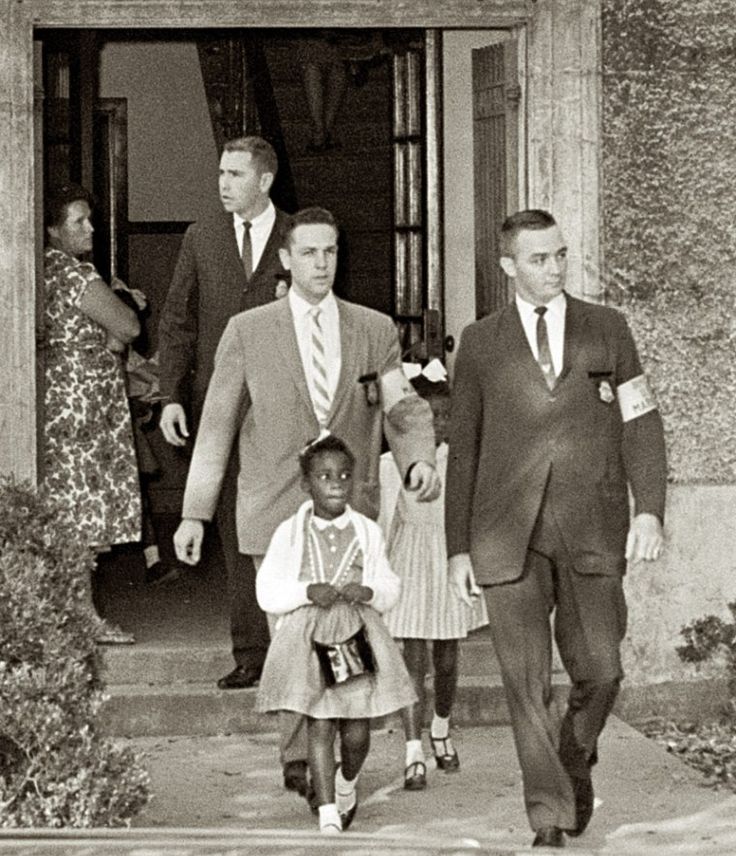
Reflecting on that day in the Lower Ninth Ward, Gail Etienne recalls anti-integration protestors “screaming and hollering” and reflects, “I was scared. Confused. . . . What could I have done to make them act that way, at six years old?” The film also features an archival recording of Tessie Prevost, who passed away in 2024. She describes the school’s proximity to her home and her father’s enthusiasm for her attendance there. Ms. Prevost’s mother, Dorothy, recounts that her husband accompanied Tessie to school, reassuring his daughter, “Just look straight ahead. Daddy is behind you. Ain’t nothing going to happen to you.” To manage her fear, Leona Tate counted the steps to McDonogh 19, stating, “It’s eighteen steps, and I’ll never forget that.” In 2009, Dr. Tate established a foundation that led to the 2022 opening of the Tate Etienne and Prevost Center (TEP Center) at the former McDonogh 19 school, which closed in 2004. This mixed-use facility offers educational programs and an exhibition space dedicated to the history of New Orleans public school desegregation, the Civil Rights Movement, and restorative justice. On the same day that Ms. Etienne, Ms. Prevost, and Dr. Tate entered the previously segregated school, Ruby Bridges became the first Black student at William Frantz Elementary School in the Upper Ninth Ward.

Images

U.S. Marshalls escort Leona Tate, Gail Etienne, and Tessie Prevost from McDonogh 19, November 14, 1960. Foreground, L to R: Leona Tate and Al Butler.

Text

Rockwell created the painting approximately a decade after Oliver Brown et al. v. Board of Education of Topeka, the 1954 Supreme Court decision that declared state-sponsored segregation unconstitutional. In 1960, following Brown, another significant Supreme Court case, Earl Benjamin Bush et al. v. Orleans Parish School Board, originated in New Orleans. Many local attorneys who prepared for the Bush case had previously advised the Brown legal team. These Louisiana attorneys, in collaboration with the local NAACP chapter, organized the school desegregation plan and selected the four children who participated. A fifth child was initially scheduled to accompany Ruby Bridges to Frantz School but was withdrawn at the last minute due to family circumstances.

The Bush case addressed the desegregation of public schools in New Orleans, focusing on a series of legislative enactments by the Louisiana legislature intended to prevent partial desegregation. A three-judge federal district court declared these enactments unconstitutional and temporarily enjoined their enforcement, finding that they were designed to prevent partial desegregation of the races in certain public schools in New Orleans pursuant to an earlier federal court order. It was contended, inter alia, that the State of Louisiana had “interposed itself in the field of public education over which it [the federal court] has exclusive control.”** This decision represented a significant advancement in the desegregation of public schools and had a lasting impact on the Civil Rights Movement.

Images

Restaging of Norman Rockwell’s studio in 1963–64, when Rockwell painted The Problem We All Live With, Norman Rockwell Museum, Stockbridge, Massachusetts, 2025. Photo courtesy of the Norman Rockwell Museum.

Text

The Problem We All Live With marks an important shift in Rockwell’s career as an illustrator, signaling his interest in speaking out on social justice and Civil Rights themes. Previously, he worked for over forty-seven years illustrating covers for the Saturday Evening Post, which had an unspoken but well understood editorial policy limiting the depiction of people of color in subservient roles. Rockwell would attempt to push the boundaries of this policy from time to time over his career, starting with his famous Four Freedoms images and through the publication of his Golden Rule cover illustration. His move to Look magazine in 1963 permitted him to explore different topics that were front and center in American society, like school desegregation, voting rights, and the Vietnam War.

The editors of Look titled the illustration The Problem We All Live With and published it as a two-page spread in the January 14, 1964, issue. Rockwell envisioned a composition that would include a single child to achieve a dramatic effect. The painting depicts a well-dressed young girl, portrayed as vulnerable, brave, and resolute, walking in profile and flanked by four United States marshals. The model, Lynda Gunn, was Rockwell’s neighbor in Stockbridge, Massachusetts. Gunn passed away in 2019. The film features her daughter, Arlyn Traylor, and other family members. Rockwell emphasized a contrast in scale by showing the marshals only from the shoulders down, dressed in suits with armbands and badges. The composition situates the viewer within the crowd. The artist depicted a racial slur and thrown tomatoes on the realistic stucco wall that forms the backdrop for the scene.

Because the composition features a single child, Ms. Bridges is often solely associated with The Problem We All Live With, which has overshadowed the participation of the model, Gunn, and the three students who desegregated McDonogh 19. The Norman Rockwell Museum’s project aims to recognize all five individuals, their families, and their communities. “We’re living in an era when we understand the importance of multiple voices interpreting an artwork,” states Norman Rockwell Museum Director and CEO Laurie Norton Moffatt, “and particularly inviting the subjects of an artwork to tell their own story in their own words.” Dennis Powell, president of the Berkshire County branch of the NAACP, adds, “Truth is the most powerful message.”

Following the screening at the Historic New Orleans Collection, a panel discussion included project team members: Dr. Barbara-Shae Jackson of NORC, who facilitated community conversations; research and interpretive consultant Margot Yale; curator and historian Eric Seiferth; and Norman Rockwell Museum digital innovation officer Rich Bradway. Ms. Etienne, members of the Prevost family, and other community members who shared their experiences also participated. Despite the depiction of school desegregation commemorated by Rockwell, many public schools in the United States remain largely segregated. Dr. Jackson asks in the film, “How can we be a nation that constructs spaces where children are not fully welcome?”

Through this profound collaboration, the New Orleans community participants, the Norman Rockwell Museum, the TEP Center, and the Historic New Orleans Collection have broadened understandings of The Problem We All Live With and the history of the United States.
Text

Notes and References

*Referring to women protesting the desegregation of the New Orleans Schools. Steinbeck, John, Travels with Charley in Search of America, Viking, New York, 1962.

**“Bush v New Orleans Parish School Board, 364 U.S. 500 (1960),” JUSTIA, accessed March 24, 2026, https://supreme.justia.com/cases/federal/us/364/500/. See also, Order in Earl Benjamin Bush, et. al. v. Orleans Parish School Board; 8/30/1960; Civil Case No. 3630; Earl Benjamin Bush, et. al. v. Orleans Parish School Board; Civil Case Files, 1938-1995; Records of District Courts of the United States, Record Group 21; National Archives at Fort Worth, Fort Worth, TX,” DOCSTeach, accessed March 24, 2026, https://docsteach.org/document/order-new-orleans-school-crisis-case/

Baker, Liva, The Second Battle of New Orleans: The Hundred-Year Struggle to Integrate the Schools, HarperCollins, New York, 1996.

Blue, Ellen, St. Mark’s and the Social Gospel: Methodist Women and Civil Rights in New Orleans, 1895–1965, University of Tennessee Press, Knoxville, 2011.