LBJ Quote:
“On September 29, 1965, President Lyndon B. Johnson signed P.L. 89-209, the National Foundation on the Arts and the Humanities Act, in the Rose Garden of the White House. This piece of legislation established the National Endowment for the Arts and the Humanities Foundation as an umbrella for the National Endowment for the Arts (NEA) and the National Endowment for the Humanities (NEH), and their respective councils” (from “Timeline of NEA Highlights” on the website of the National Endowment for the Arts). On this occasion, President Johnson said: “Art is a nation’s most precious heritage. For it is in our works of art that we reveal ourselves, and to others, the inner vision which guides us as a nation. And where there is no vision, the people perish.”
Bauerlein, Mark, and Ellen Grantham, National Endowment for the Arts: A History: 1965–2008, Washington, DC: National Endowment for the Arts, 2009.
United States Congress. National Foundation on the Arts and the Humanities Act of 1965. S.1483, 89th Cong., 1st sess. (1965). https://www.congress.gov/bill/89th-congress/senate-bill/1483/text/pl.
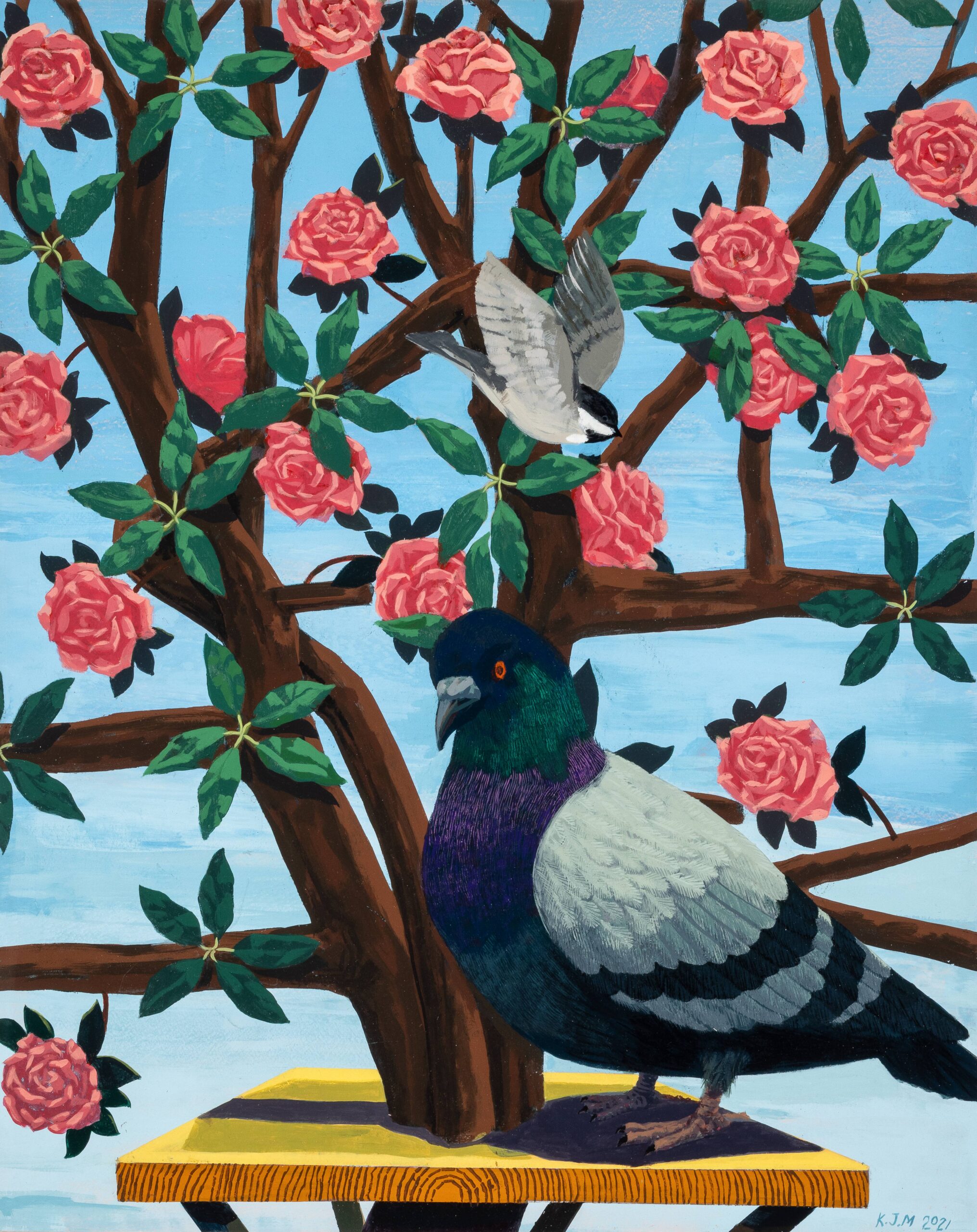
Black and Part-Black Birds in America: (Pigeon and Black-Capped Chickadee No. 2)
Broyard, Bliss, One Drop: My Father’s Hidden Life–A Story of Race and Family Secrets (Boston: Little, Brown, 2007):
“In this acclaimed memoir, Bliss Broyard, the daughter of the literary critic Anatole Broyard, examines her father’s decision to conceal his racial identity and the impact of this revelation on her own life. Two months before he died, renowned literary critic Anatole Broyard called his grown son and daughter to his side to impart a secret he had kept all their lives and most of his own: he was Black. Born in the French Quarter in 1920, Anatole had begun to conceal his racial identity after his family moved to Brooklyn and his parents resorted to ‘passing’ to get work.”—from the publisher’s description of the book.
Farrington, Lisa, African American Art: A Visual and Cultural History. New York: Oxford University Press, 2017, 345–47.
Thomas Jefferson to Francis C. Gray, March 4, 1815. Founders Online. National Archives.
Marshall, Kerry James. “Shall I Compare Thee . . . ?” In Kerry James Marshall: Mastry, edited by Helen Molesworth, 79. New York: Skira Rizzoli, 2016.
Marshall, Kerry James. “Sticks and Stones . . . but Names . . .” in Kerry James Marshall: Mastry, edited by Helen Molesworth, pp.232-45 New York: Skira Rizzoli. Originally published in Bill Traylor, William Edmonson and the Modernist Impulse. Exhibition catalog. Urbana-Champaign: Krannert Art Museum, University of Illinois, 2004.
Marshall, Kerry James. “Kerry James Marshall in Conversation.” Interview by Angela Choon. David Zwirner Gallery, July 2020. https://www.davidzwirner.com/news/2020/kerry-james-marshall-in-conversation.
Museum of Contemporary Art Chicago. “Kerry James Marshall: Mastry.” https://mcachicago.org/Publications/Websites/Kerry-James-Marshall-Mastry.
Wright, Beryl, and Gary A. Reynolds, eds. Against the Odds: African American Artists and the Harmon Foundation. Exhibition catalog. Newark, NJ: The Newark Museum, New Jersey, 1989.
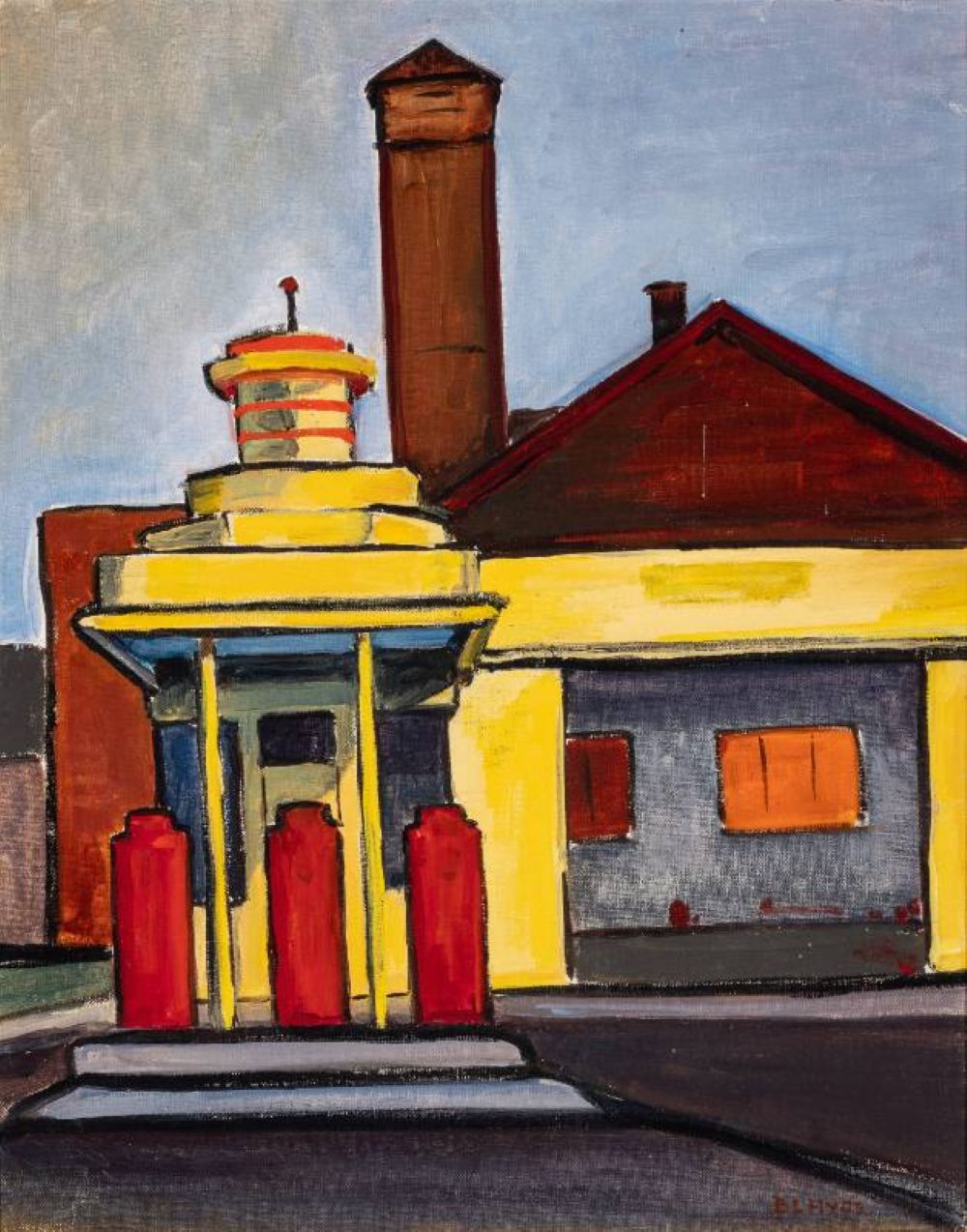
Untitled work on canvas by B.L. Hyde
Pamela Hyde Smith, the artist’s granddaughter, donated this painting to the Terra Foundation for American Art. The gift was facilitated by David F. Martin, Curator at the Cascadia Art Museum in Edmonds, Washington, and curator of Structure and Form: The Art of B.L. Hyde (Cascadia Art Museum, October 9, 2024–February 2, 2025).
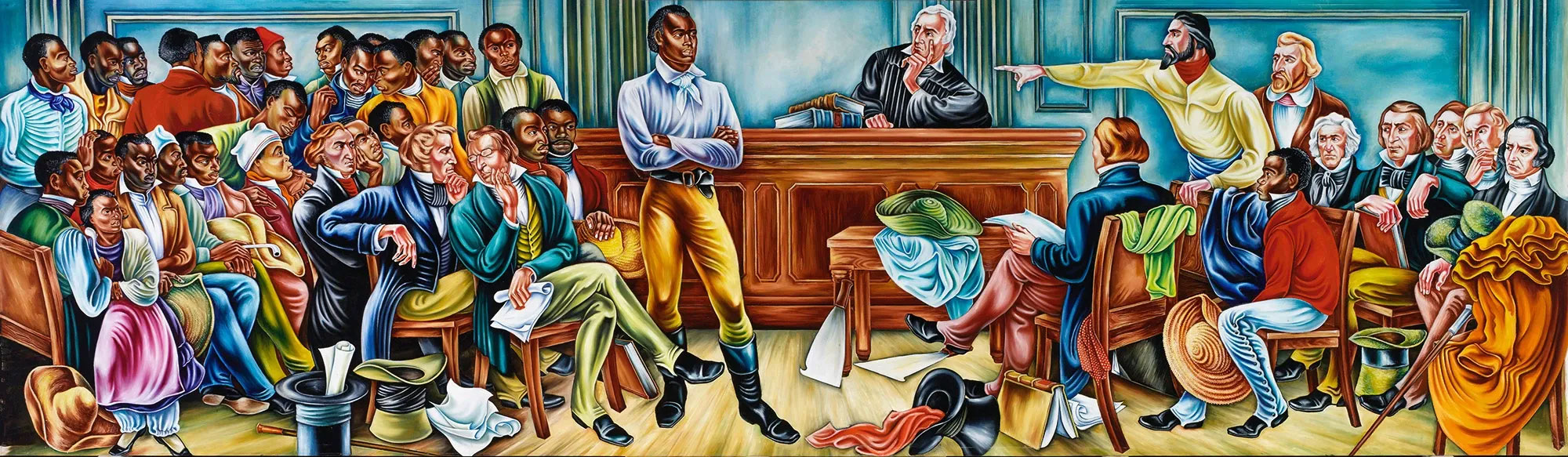
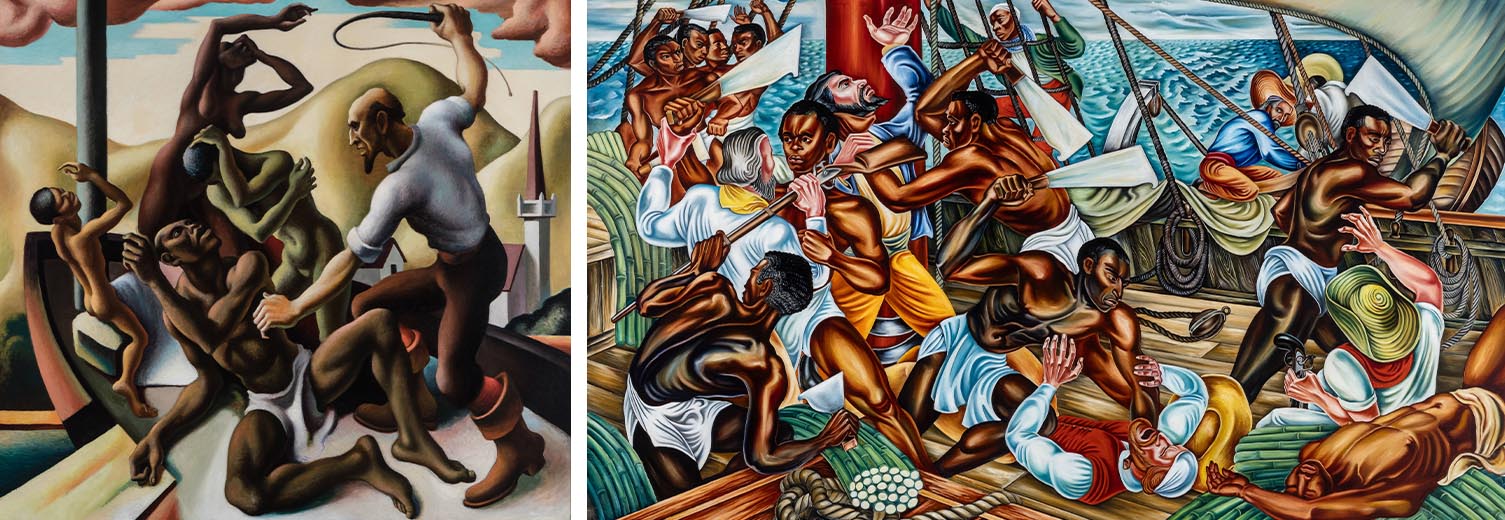
The Mutiny on the Amistad, 1939, The Trial of the Amistad Captives, 1939, and Repatriation of the Freed Captives, 1939, by Hale A. Woodruff and assisted by Robert Neal
Porter, James A., Modern Negro Art. New York: The Dryden Press, 1943, 121.
*Porter uses the term “slaves,” which should be “captives,” as the defense in the Amistad case proved that the African captives were not enslaved but free persons.
Talladega College Archives and Special Collections: See https://library.talladega.edu/archives-and-special-collections/talladega-college-historical-collection.
Beard, Augustus Field. A Crusade of Brotherhood: A History of the American Missionary
Association. Boston: The Pilgrim Press, 1909.
Blanchard, F. Q. “A Quarter Century in the American Missionary Association.” Journal of Negro Education (1937): 152–56.
Blight, David W. Yale and Slavery: A History. New Haven, CT: Yale University Press, 2024.
Brady, Patricia. “Trials and Tribulations: American Missionary Association Teachers and Black Education in Occupied New Orleans, 1863–1864.” Louisiana History 31, no. 1 (1990): 5–20. https://www.jstor.org/stable/i390428.
Click, Patricia C. Time Full of Trial: The Roanoke Island Freedmen’s Colony, 1862–1867. Chapel Hill: University of North Carolina Press, 2003.
“College President at 29; The Rev. B.G. Gallagher of Passaic Is Elected at Talladega.” New York Times, July 25, 1933, 10.
Crawford, George W. “The Rising Generation and the Door of Hope.” The American Missionary 58, no. 2 (1904): 37–42.
Crawford, George W. Thirty-four Selected Opinions of George W. Crawford, New Haven, CT: Corporation Counsel of the City of New Haven, 1972.
DeBoer, Clara Merritt. His Truth Is Marching On: African Americans Who Taught the Freedmen for the American Missionary Association, 1861–1877. New York: Routledge, 2016.
De Boer, Clara Merritt. “The Role of Afro-Americans in the Origin and Work of the American
Missionary Association: 1839–1877.” PhD diss., Rutgers, The State University of New Jersey.
Drake, Richard. “The American Missionary Association and the Southern Negro, 1861–1888.” PhD diss., Emory University, 1957.
Fuke, Richard Paul. “Land, Lumber, and Learning: The Freedmen’s Bureau, Education, and the Black Community in Post-Emancipation Maryland.” In The Freedmen’s Bureau and Reconstruction: Reconsiderations, edited by Paul A. Cimbala and Randall M. Miller, 288–314. New York: Fordham University Press, 1999.
Goldhaber, Michael. “A Mission Unfulfilled: Freedmen’s Education in North Carolina, 1865–1870.” Journal of Negro History 77, no. 4 (1992): 199–210. https://www.jstor.org/stable/3031474.
Harrold, Stanley. The Abolitionists and the South, 1831–1861. Lexington: University Press of Kentucky, 1995.
Johnson, Charles S. “The American Missionary Association Institute of Race Relations.” Journal of Negro Education 13 (1944): 568–74. https://www.jstor.org/stable/2292517.
Jones, Jacqueline. “Women Who Were More Than Men: Sex and Status in Freedmen’s Teaching.”
History of Education Quarterly 19, no. 1 (1979): 47–59. https://www.jstor.org/stable/367809.
McPherson, James M. The Struggle for Equality: Abolitionists and the Negro in the Civil War and Reconstruction. Princeton, NJ: Princeton University Press, 1964.
McPherson, James M. The Abolitionist Legacy: From Reconstruction to the NAACP. Princeton, NJ: Princeton University Press, 1995.
Morris, Robert C. Reading,’Riting, and Reconstruction: The Education of Freedmen in the South, 1861–1870. Chicago: University of Chicago Press, 1981.
Pearce, Larry Wesley. “The American Missionary Association and the Freedmen in Arkansas, 1863–1878.” Arkansas Historical Quarterly 30, no. 2 (1971): 123–44. https://www.jstor.org/stable/40038073.
Richardson, E. Allen. “Architects of a Benevolent Empire: The Relationship Between the American Missionary Association and the Freedmen’s Bureau in Virginia, 1865–1872.” In The Freedmen’s Bureau and Reconstruction: Reconsiderations, edited by Paul A. Cimbala and Randall M. Miller, 119–39. New York: Fordham University Press, 1999.
Richardson, Joe M. Christian Reconstruction: The American Missionary Association and Southern Blacks, 1861–1890. Tuscaloosa: University of Alabama Press, 2009.
Richardson, Joe M., and Maxine D. Jones. Education for Liberation: The American Missionary Association and African Americans, 1890 to the Civil Rights Movement. Tuscaloosa: University of Alabama Press, 2015.
Richardson, Joe M. “Christian Abolitionism: The American Missionary Association and the Florida Negro.” Journal of Negro Education 40, no. 1 (1971): 35–44. https://www.jstor.org/stable/2966922.
Richardson, Joe M. “‘We Are Truly Doing Missionary Work’: Letters from American Missionary Association Teachers in Florida, 1864–1874.” Florida Historical Quarterly 54, no. 2 (1975): 178–95. https://www.jstor.org/stable/30147336.
Richardson, Joe M. “The Negro in Post–Civil War Tennessee: A Report by a Northern Missionary.” Journal of Negro Education 34, no. 4 (1965): 419–24. https://www.jstor.org/stable/2294093.
Richardson, Joe M. “Fisk University: The First Critical Years.” Tennessee Historical Quarterly 29, no. 1 (1970): 24–41. https://www.jstor.org/stable/42623127.
Van Nort, Sydney C. The City College of New York. Charleston, SC: Arcadia Press, 2007.
Vaughn, William Preston. Schools for All: The Blacks & Public Education in the South, 1865–1877. Lexington: University Press of Kentucky, 1974.
Weisenfeld, Judith. “‘Who Is Sufficient for These Things?’ Sara G. Stanley and the American Missionary Association, 1864–1868.” Church History 60, no. 4 (1991): 493–507. https://www.jstor.org/stable/3169030?item_view=journal_info.
Zipf, Karin L. “‘Among These American Heathens’: Congregationalist Missionaries and African American Evangelicals during Reconstruction, 1865–1878.” North Carolina Historical Review 74, no. 2 (1997): 111–34. https://www.jstor.org/stable/23521220.