Skip to content

Text

“Art is a nation’s most precious heritage. For it is in our works of art that we reveal ourselves, and to others, the inner vision which guides us as a nation. And where there is no vision, the people perish.”

-President Lyndon B. Johnson, September 29, 1965

Philanthropy functions as a social enterprise, supporting innovative strategies to address societal challenges and bridging gaps in current systems. The Terra Foundation for American Art has articulated a mission to foster intercultural dialogue and promote transformative practices that broaden narratives of American art. Our current mission statement clarifies the foundation’s objectives and strategic direction and provides a framework for advancing the legacy and contributions of all American artists.

The approach outlined below to expanding the narratives of American art emphasizes the relationship between art and participatory democracy. It underscores solidarity within artistic movements and highlights the Terra Foundation’s unique role among philanthropic organizations in shaping the narrative of American art.

Images

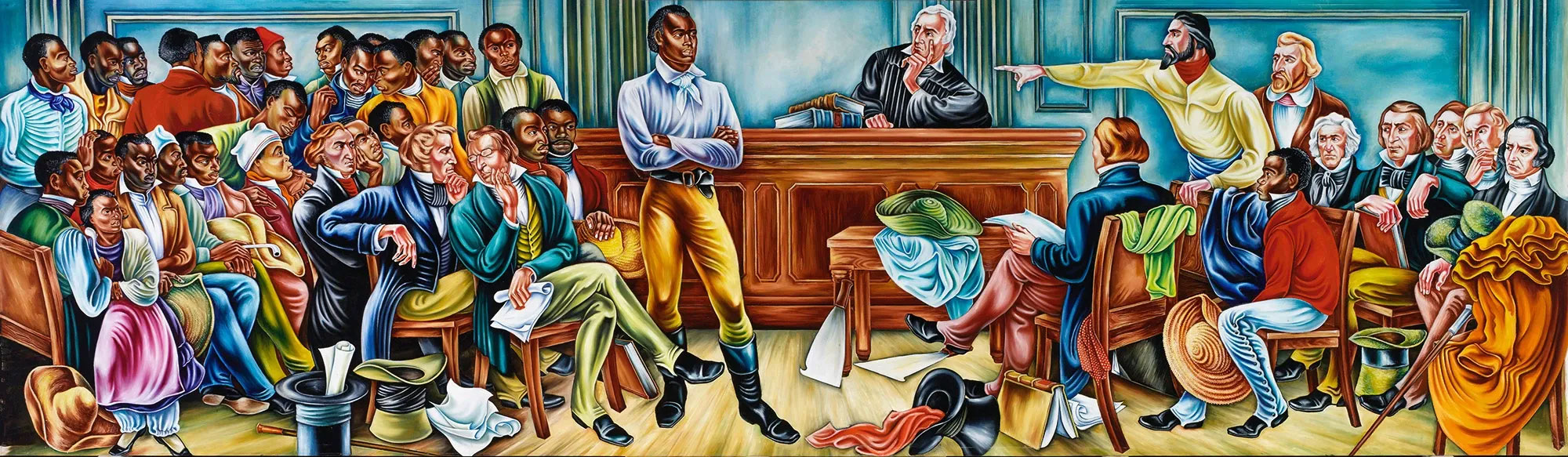
Men in a courtroom

Hale A. Woodruff assisted by Robert L. Neal, The Trial of the Amistad Captives, 1939. Oil on canvas, 71 x 242 ¼ in. (180.3 x 615.3 cm), Co-stewarded by Terra Foundation for American Art, Daniel J. Terra Art Acquisition Fund, and Art Bridges Foundation. Commissioned by Buell G. Gallagher and George W. Crawford for Talladega College, Savery Library, Alabama. The commission was supported in part by the American Missionary Association of New York (AMA), TCA2025.3, AB.2025.64.

Text

Long- and short-term loans to institutions for viewing, interpretation, and study allow the Terra Foundation to share American art and its stories locally and globally. Artworks are acquired through three primary methods: direct acquisitions using dedicated endowed funds; co-acquisitions with partner institutions; and gifts or bequests. Daniel J. Terra (1911–1996) began collecting art in 1937, initially acquiring minor English and French landscapes from the eighteenth and nineteenth centuries. In the early 1970s, motivated by the upcoming US bicentennial and increased access to American art, Terra redirected his focus to American works. This shift established an enduring foundation for his collection strategy in the years that followed.

In 2023 and 2024, the Terra Foundation for American Art Board of Directors approved the acquisition of David C. Driskell’s (American, 1931–2020) painting Gabriel (1965), Melvin Edwards’s (American, 1937–2026) mobile sculpture Good Friends in Chicago (1971), and an untitled oil on canvas (c. 1960) by Alma W. Thomas (American, 1891–1978). These acquisitions demonstrate the foundation’s commitment to evolve the Terra Foundation Art Collection beyond 1945 to more fully include narratives that expand understandings of American art and history.

Quotation

“These acquisitions demonstrate the foundation’s commitment to evolve the Terra Foundation Art Collection beyond 1945 to more fully include narratives that expand understandings of American art and history.”

Turry M. Flucker, Vice President of Collections and Partnerships

Images

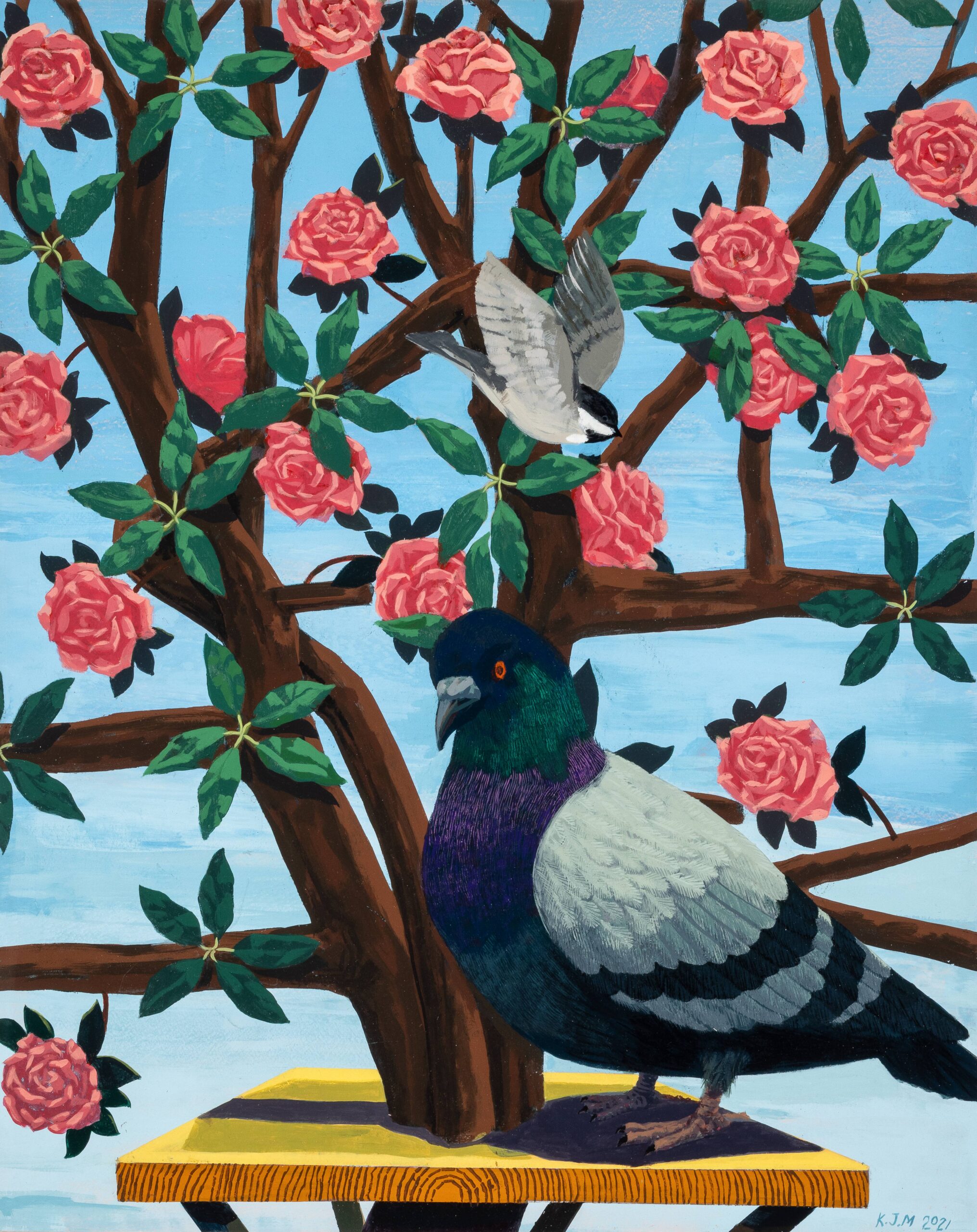
An image of a bird sitting on a tree with pink flowers.

Kerry James Marshall, Black and Part Black Birds in America: (Pigeon and Black Capped Chickadee no 2), 2021. Acrylic on PVC panel in artist's frame, 30 x 24 1/2 x 2 3/4 in. (76.2 x 62.2 x 7 cm), Terra Foundation for American Art, Daniel J. Terra Art Acquisition Fund, 2025.1

Text

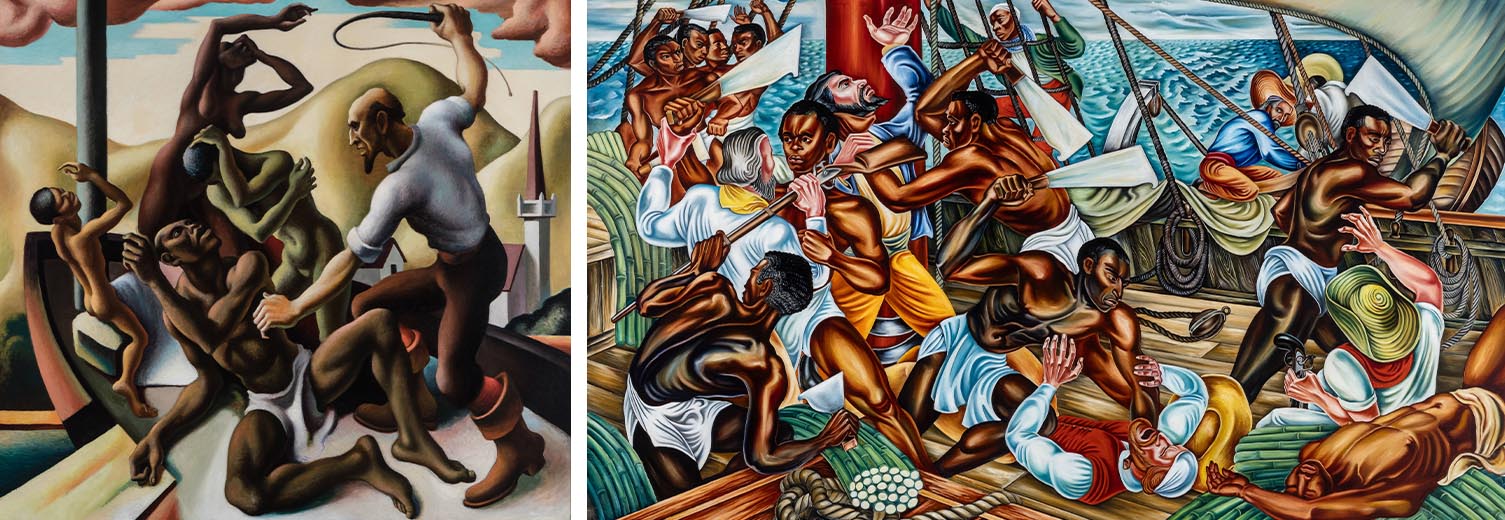
In 2025 and 2026, the board of directors approved the acquisition of Black and Part Black Birds in America: (Pigeon and Black Capped Chickadee no. 2) (2021) by Kerry James Marshall (American, born 1955). During this period, the foundation also co-acquired, with the Art Bridges Foundation, three significant canvases: The Mutiny on the Amistad (1939), The Trial of the Amistad Captives (1939), and Repatriation of the Freed Captives (1939), all by Hale A. Woodruff (American, 1900–1980) in collaboration with Robert L. Neal (American, 1916–1987). These works advance scholarship in American art mural studies and articulate narratives of resistance, interracial collaboration, and global conflicts, with particular focus on the institution of slavery and on abolitionism. Furthermore, they offer a critical response to the Terra-owned Slaves (1925), a panel from The American Historical Epic (1919–28) by Thomas Hart Benton (American, 1889–1975), which reinterprets early American history through the lens of conflict and economic exploitation.

Images

Left: Thomas Hart Benton, Slaves, 1925. Oil on cotton duck mounted on board, 66 7/16 x 72 3/8 in. (168.8 x 183.8 cm), Terra Foundation for American Art, Daniel J. Terra Art Acquisition Endowment Fund, 2003.4
Right: Hale A. Woodruff assisted by Robert L. Neal, The Mutiny on the Amistad, 1939. Oil on canvas, 71 ¼ x 125 3/8 in. (181 x 318.5 cm), Co-stewarded by Terra Foundation for American Art, Daniel J. Terra Art Acquisition Fund, and Art Bridges Foundation. Commissioned by Buell G. Gallagher and George W. Crawford for Talladega College, Savery Library, Alabama. The commission was supported in part by the American Missionary Association of New York (AMA), TCA2025.2, AB.2025.63.

Text

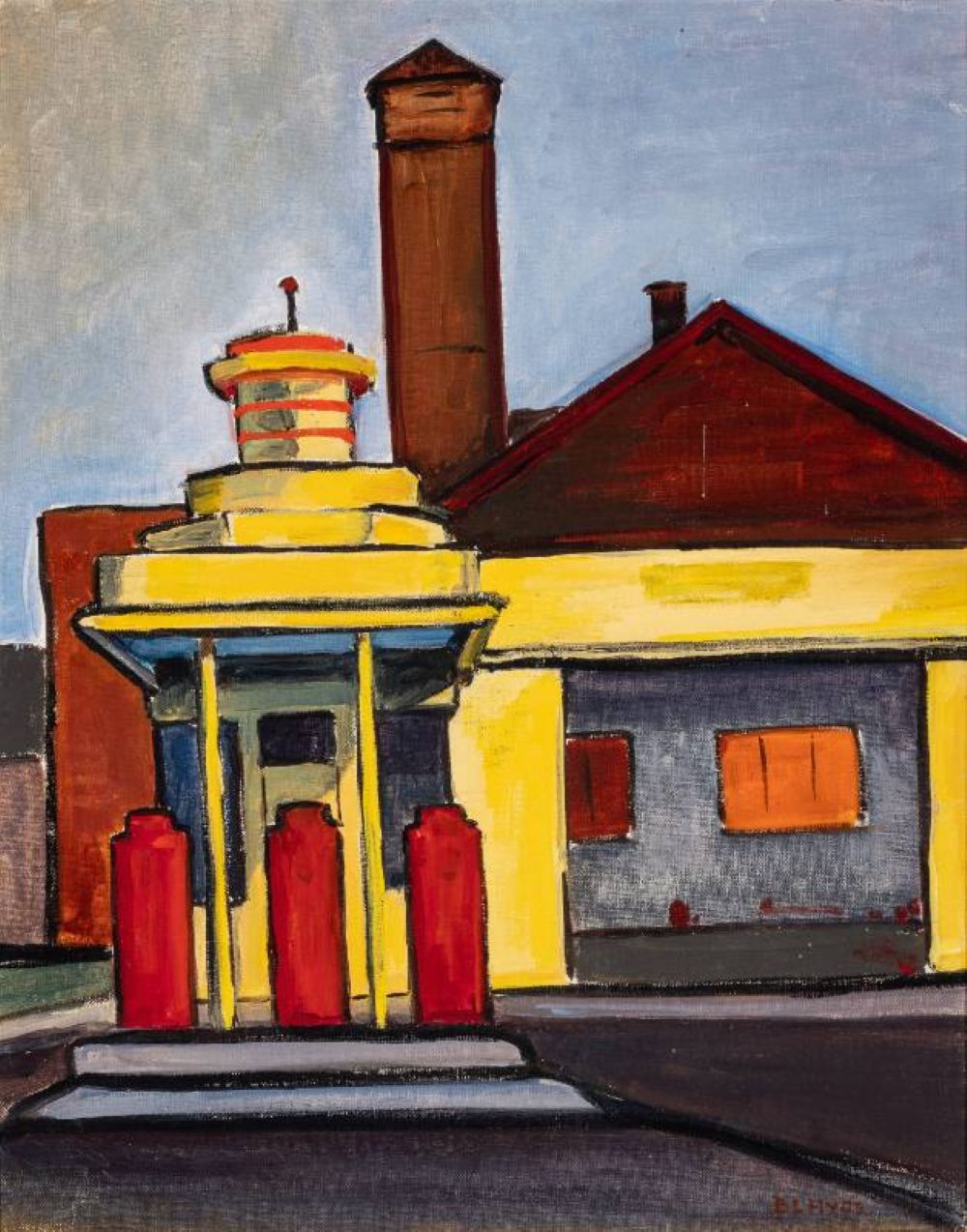
The foundation also received a gift of an untitled canvas (1933–1940) by B. L. Hyde (American, 1886–1983), further demonstrating its commitment to recognizing artists from diverse regions.

_____________

Black and Part Black Birds in America: (Pigeon and Black Capped Chickadee no. 2), 2021, by Kerry James Marshall

Kerry James Marshall (American, 1955) is an artist and professor recognized for his depictions of African American figures. Born in Birmingham, Alabama, he relocated to South Central Los Angeles as a child and later established himself as an artist in Chicago. Marshall’s paintings, installations, and public projects are informed by African American culture and his personal experiences. While in high school he began figure drawing under the mentorship of Charles W. White (American, 1918–1979), a Chicago-born painter with Southern influences and roots, and continued this practice throughout college.

Black and Part Black Birds in America: (Pigeon and Black Capped Chickadee no. 2) is part of a series of paintings initiated in 2020 that references ornithologist, naturalist, and painter John James Audubon’s (French-American, 1785–1851) seminal work, The Birds of America, originally published in sections from 1827 to 1839. The Birds of America comprises 435 hand-colored engravings based on Audubon’s life-sized watercolors of North American birds, including several extinct species. This volume, regarded as foundational in naturalism and ecology, merges Audubon’s artistic skill with his passion for nature and taxonomy. The series also broadly references the traditions of ornithologists and naturalists.

During the early to mid-nineteenth centuries, slavery was legal in a substantial portion of the United States, and race was viewed as something akin to a science, not far from the ongoing effort to classify the animal kingdom. In 1815—three years after Audubon received his US citizenship—former president Thomas Jefferson wrote to Francis C. Gray, a Massachusetts politician, specifying the percentage of blood that constituted a legal definition of Black or white, enslaved or free. He states, “it becomes a Mathematical problem of the same class with those on the mixtures of different liquors or different metals.” Ultimately, through his calculations, Jefferson concluded that a person with one-quarter or more African lineage should be considered Black: “1/4 it is understood in Natural history that a fourth cross of one race of animals with another gives an issue equivalent for all sensible purposes to the original blood.” As such, as Marshall has written, “in race-conscious America, ‘passing’ as white has historically been one way for some people of color to infiltrate the sacrosanct ranks of the privileged. Success depended squarely upon one’s Blackness going undetected.”

When Harry Willson Watrous painted The Drop Sinister, What Shall We Do with It?, around 1913, it was visually similar to his other works but unique for addressing a social and moral issue. The painting appears to depict a mixed marriage, illegal in many states at the time. The Crisis, the National Association for the Advancement of Colored People (N.A.A.C.P.) journal edited by W.E.B. Du Bois, had a different idea about the picture:

Du Bois writes: “The people in this picture are all ‘colored’; that is to say, the ancestors of all of them two or three generations ago numbered among them full-blooded Negroes. These ‘colored’ folk married and brought to the world a little golden-haired child; today, they pause for a moment and sit aghast when they think of this child’s future…” Marshall addresses similar social and moral issues in the age of the COVID-19 pandemic and racial unrest at the beginning of the 2020s.

Images

A man and a woman sitting at a table.

Harry Willson Watrous (American, 1857–1940), The Drop Sinister—What Shall We Do with It?, c. 1913. Oil on canvas, 37 x 50 ¼ in. (94 x 127.6 cm). Portland Museum of Art, Maine, Gift of the artist, 1919.18. Image courtesy Luc Demers.

Text

Marshall became aware of Audubon’s racial heritage when he attended the landmark 1976 exhibition Two Centuries of Black American Art, organized by David C. Driskell (American, 1931–2020), at the Los Angeles County Museum of Art. Audubon was born in the French colony of Saint-Domingue, present-day Haiti, to Lieutenant Jean Audubon, a French naval officer, and Jeanne Rabine, a woman of color. Driskell’s survey showcased the work of African American artists from 1750 to 1950, whose contributions to American art had largely been dismissed or ignored.

Images

A picture of a yellow house.

Beulah Loomis Hyde, Untitled, c. 1935–40. Oil on canvas, 20 x 16 in. (50.8 x 40.64 cm), Terra Foundation for American Art, Gift of the B.L. Hyde Estate, 2026.1

Text

Untitled, c. 1935–40, by B. L. Hyde

Beulah Loomis Hyde (American, 1886–1983) depicted industrial landscapes of Washington State in the early twentieth century, integrating modernist techniques with Precisionist and Surrealist influences. She became a prominent regional artist, and it is likely that she signed her work “B. L.” to conceal her gender. In this late-1930s composition, three gas pumps anchor a red-and-yellow kiosk, with a smokestack in the background. Simplified, geometric buildings in subdued tones contribute to the overall starkness of the composition. The use of clean lines and space suggests both the modern mobility associated with automobiles and a subtle sense of isolation.

________________

The Mutiny on the Amistad, 1939, The Trial of the Amistad Captives, 1939, and Repatriation of the Freed Captives, 1939, by Hale A. Woodruff and assisted by Robert Neal

Images

Hale A. Woodruff assisted by Robert L. Neal, The Repatriation of the Freed Captives, 1939. Oil on canvas, 71 3/8 x 123 7/8 in. (181.3 x 314.6 cm), Co-stewarded by Terra Foundation for American Art, Daniel J. Terra Art Acquisition Fund, and Art Bridges Foundation. Commissioned by Buell G. Gallagher and George W. Crawford for Talladega College, Savery Library, Alabama. The commission was supported in part by the American Missionary Association of New York (AMA), TCA2025.4, AB.2025.65.

Text

Hale A. Woodruff was born in Cairo, Illinois, on August 26, 1900, but he was, at heart, a product of the American South. He grew up in Nashville, Tennessee, where he attended local schools. Woodruff returned to the North and studied at the Herron School of Art and Design in Indianapolis, the Art Institute of Chicago, and the Harvard Fogg Art Museum. Woodruff won a Harmon Foundation award in 1926, which enabled him to spend four years studying in Paris from 1927 to 1931. In 1931, John Hope (1868–1936), president of Atlanta University (an AMA institution established in 1865), was working to expand the university’s programs. Hope persuaded Woodruff to return to the US with the offer of establishing an art department at the university. Woodruff returned amid the pressures of the Great Depression and began building Atlanta University’s art department. In 1936, Woodruff traveled to Mexico to study as an apprentice under the renowned muralist Diego Rivera (Mexican, 1886–1957). There, he learned Rivera’s fresco technique and developed an interest in portraying figures. He returned to Atlanta and continued teaching and making art.

From the 1960s until his death, Hale Woodruff continued to create and collaborate with other artists. In particular, his work included the Celestial Gate series, which he began in the early 1950s and continued into the late 1970s. This series showcased his deft ability to work abstractly and to incorporate traditional African iconography. American artist and art historian James A. Porter, in Modern Negro Art (1943), comments on the Amistad Series mural paintings by Hale A. Woodruff (American, 1900–1980), assisted by Robert L. Neal: “Where in all American art can one find a more remarkable grouping of Black and white faces than in the second panel of this series, showing the slaves* on trial at New Haven, Connecticut? Apart from the thorough research that the artist has expended on the costumes of the figures, there is also a variety of posture, gesture, facial expression, and grouping that builds the ‘psychological motif’ or the dramatic tension of the whole. It must be conceded that not only does Woodruff exhibit here a fine sense of design, but also shows himself gifted with the retrospective imagination that is as indispensable to the great mural artist as to the historian [. . .]. The entire series of panels are a delight to the eye.”

It was 1938, and racial tensions were high across Depression-era America. Talladega College President Buell G. Gallagher (1904–1978) believed that a new library on the college’s campus, intended for use by students, faculty, and the residents of Talladega, would be a statement of “interracial harmony and intellectual advancement.” Gallagher, an educator, writer, administrator, and champion for social change, had been commissioned by the anti-caste and antislavery society the American Missionary Association (AMA) to lead Talladega. He planned the new library in partnership with George W. Crawford (1877–1972), chairman of the college’s Board of Trustees. Crawford was a member of Talladega’s class of 1900, as well as a Yale Law School graduate (1903) awarded the prestigious Townsend Prize for oration while attending the school. He was also a member of the AMA.

Gallagher and Crawford commissioned American artist Hale A. Woodruff to paint a series of large canvases for the library building’s lobby. The AMA provided full financial support to Woodruff. Three of these mural paintings depict the story of the Amistad incident in 1839 and its aftermath.

Text

References, Notes, Additional Reading

LBJ Quote:

“On September 29, 1965, President Lyndon B. Johnson signed P.L. 89-209, the National Foundation on the Arts and the Humanities Act, in the Rose Garden of the White House. This piece of legislation established the National Endowment for the Arts and the Humanities Foundation as an umbrella for the National Endowment for the Arts (NEA) and the National Endowment for the Humanities (NEH), and their respective councils” (from “Timeline of NEA Highlights” on the website of the National Endowment for the Arts). On this occasion, President Johnson said: “Art is a nation’s most precious heritage. For it is in our works of art that we reveal ourselves, and to others, the inner vision which guides us as a nation. And where there is no vision, the people perish.”

Bauerlein, Mark, and Ellen Grantham, National Endowment for the Arts: A History: 1965–2008, Washington, DC: National Endowment for the Arts, 2009.

United States Congress. National Foundation on the Arts and the Humanities Act of 1965. S.1483, 89th Cong., 1st sess. (1965). https://www.congress.gov/bill/89th-congress/senate-bill/1483/text/pl.

Black and Part-Black Birds in America: (Pigeon and Black-Capped Chickadee No. 2)
Broyard, Bliss, One Drop: My Father’s Hidden Life–A Story of Race and Family Secrets (Boston: Little, Brown, 2007):

“In this acclaimed memoir, Bliss Broyard, the daughter of the literary critic Anatole Broyard, examines her father’s decision to conceal his racial identity and the impact of this revelation on her own life. Two months before he died, renowned literary critic Anatole Broyard called his grown son and daughter to his side to impart a secret he had kept all their lives and most of his own: he was Black. Born in the French Quarter in 1920, Anatole had begun to conceal his racial identity after his family moved to Brooklyn and his parents resorted to ‘passing’ to get work.”—from the publisher’s description of the book.

Farrington, Lisa, African American Art: A Visual and Cultural History. New York: Oxford University Press, 2017, 345–47.

Thomas Jefferson to Francis C. Gray, March 4, 1815. Founders Online. National Archives.

Marshall, Kerry James. “Shall I Compare Thee . . . ?” In Kerry James Marshall: Mastry, edited by Helen Molesworth, 79. New York: Skira Rizzoli, 2016.

Marshall, Kerry James. “Sticks and Stones . . . but Names . . .” in Kerry James Marshall: Mastry, edited by Helen Molesworth, pp.232-45 New York: Skira Rizzoli. Originally published in Bill Traylor, William Edmonson and the Modernist Impulse. Exhibition catalog. Urbana-Champaign: Krannert Art Museum, University of Illinois, 2004.

Marshall, Kerry James. “Kerry James Marshall in Conversation.” Interview by Angela Choon. David Zwirner Gallery, July 2020. https://www.davidzwirner.com/news/2020/kerry-james-marshall-in-conversation.

Museum of Contemporary Art Chicago. “Kerry James Marshall: Mastry.” https://mcachicago.org/Publications/Websites/Kerry-James-Marshall-Mastry.

Wright, Beryl, and Gary A. Reynolds, eds. Against the Odds: African American Artists and the Harmon Foundation. Exhibition catalog. Newark, NJ: The Newark Museum, New Jersey, 1989.

Untitled work on canvas by B.L. Hyde

Pamela Hyde Smith, the artist’s granddaughter, donated this painting to the Terra Foundation for American Art. The gift was facilitated by David F. Martin, Curator at the Cascadia Art Museum in Edmonds, Washington, and curator of Structure and Form: The Art of B.L. Hyde (Cascadia Art Museum, October 9, 2024–February 2, 2025).

The Mutiny on the Amistad, 1939, The Trial of the Amistad Captives, 1939, and Repatriation of the Freed Captives, 1939, by Hale A. Woodruff and assisted by Robert Neal

Porter, James A., Modern Negro Art. New York: The Dryden Press, 1943, 121.

*Porter uses the term “slaves,” which should be “captives,” as the defense in the Amistad case proved that the African captives were not enslaved but free persons.

Talladega College Archives and Special Collections: See https://library.talladega.edu/archives-and-special-collections/talladega-college-historical-collection.

Beard, Augustus Field. A Crusade of Brotherhood: A History of the American Missionary
Association
. Boston: The Pilgrim Press, 1909.

Blanchard, F. Q. “A Quarter Century in the American Missionary Association.” Journal of Negro Education (1937): 152–56.

Blight, David W. Yale and Slavery: A History. New Haven, CT: Yale University Press, 2024.

Brady, Patricia. “Trials and Tribulations: American Missionary Association Teachers and Black Education in Occupied New Orleans, 1863–1864.” Louisiana History 31, no. 1 (1990): 5–20. https://www.jstor.org/stable/i390428.

Click, Patricia C. Time Full of Trial: The Roanoke Island Freedmen’s Colony, 1862–1867. Chapel Hill: University of North Carolina Press, 2003.

“College President at 29; The Rev. B.G. Gallagher of Passaic Is Elected at Talladega.” New York Times, July 25, 1933, 10.

Crawford, George W. “The Rising Generation and the Door of Hope.” The American Missionary 58, no. 2 (1904): 37–42.

Crawford, George W. Thirty-four Selected Opinions of George W. Crawford, New Haven, CT: Corporation Counsel of the City of New Haven, 1972.

DeBoer, Clara Merritt. His Truth Is Marching On: African Americans Who Taught the Freedmen for the American Missionary Association, 1861–1877. New York: Routledge, 2016.

De Boer, Clara Merritt. “The Role of Afro-Americans in the Origin and Work of the American

Missionary Association: 1839–1877.” PhD diss., Rutgers, The State University of New Jersey.

Drake, Richard. “The American Missionary Association and the Southern Negro, 1861–1888.” PhD diss., Emory University, 1957.

Fuke, Richard Paul. “Land, Lumber, and Learning: The Freedmen’s Bureau, Education, and the Black Community in Post-Emancipation Maryland.” In The Freedmen’s Bureau and Reconstruction: Reconsiderations, edited by Paul A. Cimbala and Randall M. Miller, 288–314. New York: Fordham University Press, 1999.

Goldhaber, Michael. “A Mission Unfulfilled: Freedmen’s Education in North Carolina, 1865–1870.” Journal of Negro History 77, no. 4 (1992): 199–210. https://www.jstor.org/stable/3031474.

Harrold, Stanley. The Abolitionists and the South, 1831–1861. Lexington: University Press of Kentucky, 1995.

Johnson, Charles S. “The American Missionary Association Institute of Race Relations.” Journal of Negro Education 13 (1944): 568–74. https://www.jstor.org/stable/2292517.

Jones, Jacqueline. “Women Who Were More Than Men: Sex and Status in Freedmen’s Teaching.”

History of Education Quarterly 19, no. 1 (1979): 47–59. https://www.jstor.org/stable/367809.

McPherson, James M. The Struggle for Equality: Abolitionists and the Negro in the Civil War and Reconstruction. Princeton, NJ: Princeton University Press, 1964.

McPherson, James M. The Abolitionist Legacy: From Reconstruction to the NAACP. Princeton, NJ: Princeton University Press, 1995.

Morris, Robert C. Reading,’Riting, and Reconstruction: The Education of Freedmen in the South, 1861–1870. Chicago: University of Chicago Press, 1981.

Pearce, Larry Wesley. “The American Missionary Association and the Freedmen in Arkansas, 1863–1878.” Arkansas Historical Quarterly 30, no. 2 (1971): 123–44. https://www.jstor.org/stable/40038073.

Richardson, E. Allen. “Architects of a Benevolent Empire: The Relationship Between the American Missionary Association and the Freedmen’s Bureau in Virginia, 1865–1872.” In The Freedmen’s Bureau and Reconstruction: Reconsiderations, edited by Paul A. Cimbala and Randall M. Miller, 119–39. New York: Fordham University Press, 1999.

Richardson, Joe M. Christian Reconstruction: The American Missionary Association and Southern Blacks, 1861–1890. Tuscaloosa: University of Alabama Press, 2009.

Richardson, Joe M., and Maxine D. Jones. Education for Liberation: The American Missionary Association and African Americans, 1890 to the Civil Rights Movement. Tuscaloosa: University of Alabama Press, 2015.

Richardson, Joe M. “Christian Abolitionism: The American Missionary Association and the Florida Negro.” Journal of Negro Education 40, no. 1 (1971): 35–44. https://www.jstor.org/stable/2966922.

Richardson, Joe M. “‘We Are Truly Doing Missionary Work’: Letters from American Missionary Association Teachers in Florida, 1864–1874.” Florida Historical Quarterly 54, no. 2 (1975): 178–95. https://www.jstor.org/stable/30147336. 

Richardson, Joe M. “The Negro in Post–Civil War Tennessee: A Report by a Northern Missionary.” Journal of Negro Education 34, no. 4 (1965): 419–24. https://www.jstor.org/stable/2294093.

Richardson, Joe M. “Fisk University: The First Critical Years.” Tennessee Historical Quarterly 29, no. 1 (1970): 24–41. https://www.jstor.org/stable/42623127.

Van Nort, Sydney C. The City College of New York. Charleston, SC: Arcadia Press, 2007.

Vaughn, William Preston. Schools for All: The Blacks & Public Education in the South, 1865–1877. Lexington: University Press of Kentucky, 1974.

Weisenfeld, Judith. “‘Who Is Sufficient for These Things?’ Sara G. Stanley and the American Missionary Association, 1864–1868.” Church History 60, no. 4 (1991): 493–507. https://www.jstor.org/stable/3169030?item_view=journal_info.

Zipf, Karin L. “‘Among These American Heathens’: Congregationalist Missionaries and African American Evangelicals during Reconstruction, 1865–1878.” North Carolina Historical Review 74, no. 2 (1997): 111–34. https://www.jstor.org/stable/23521220.